Haitian Vodou is a complex and deeply historical spiritual tradition that encompasses a vast pantheon of spirits known as Lwa. Among these entities, few are as captivating or as widely revered as Erzulie Freda (often spelled Ezili Freda). She is the spirit of romantic love, beauty, luxury, and refinement. Yet, her character is far more intricate than a simple deity of affection; she embodies the profound longing for perfection and the inevitable sorrow that arises when reality fails to meet that ideal.
For practitioners and cultural observers alike, understanding Erzulie Freda requires looking beyond surface-level descriptions of jewelry and perfume. She represents a specific archetype within the Haitian social and spiritual consciousness—the Metres (mistress) who demands the best the world has to offer.
Her presence in a ceremony brings an air of elegance and sophistication, but it also carries a weight of emotional complexity that reflects the human condition itself.
This exploration delves into the origins, symbolism, and ritual practices associated with Erzulie Freda. By examining her role within the Rada rite, her relationship with other spirits, and the specific ways she is honored, we gain insight into how this powerful Lwa influences the lives of her devotees and shapes the broader narrative of Vodou theology.
The Rada Rite and Dahomean Origins
To understand Erzulie Freda, one must first understand her place within the structure of Vodou. The religion divides its spirits into different “nations” or rites, with the two most prominent being the Rada and the Petro. The Rada spirits are generally associated with coolness, wisdom, and roots in Dahomey (modern-day Benin). They are often viewed as benevolent, though they command immense respect and strict adherence to protocol.
Erzulie Freda belongs to the Rada nation, although her temperament can sometimes blur the lines between the cool Rada spirits and the hotter, more volatile Petro spirits. Historically, her roots trace back to West African river deities, but in Haiti, she evolved into a distinct personification of femininity and grace.
As a Rada spirit, she is associated with water, freshness, and the color white, often accented with pink to symbolize romance and sweetness.
In the cosmology of Vodou, the Rada Lwa are the guardians of tradition and moral order. Erzulie Freda’s role within this group is to uphold the standards of beauty and etiquette. She is the civilizing force that rejects squalor and rudeness. When she manifests in possession, the atmosphere of the temple (peristyle) shifts immediately; the rough edges of daily life are smoothed over, and the participants must present themselves with heightened dignity and decorum.
Iconography and Syncretism: The Mater Dolorosa
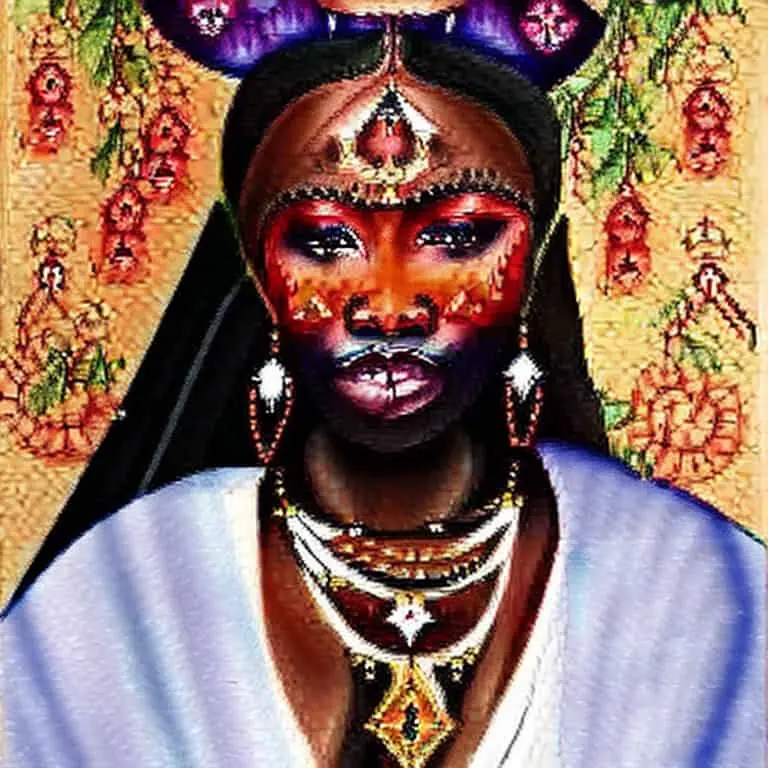
Visual symbols are central to Vodou worship, serving as focal points for devotion and connection. Erzulie Freda is syncretized with the Catholic image of the Mater Dolorosa (Our Lady of Sorrows).
This association is not random; it is deeply rooted in the iconography of the saint, specifically the depiction of the Virgin Mary with a heart pierced by a sword (or sometimes three swords) and adorned with rich jewelry and robes.
For the uninitiated, the sword piercing the heart might suggest violence, but in the context of Erzulie Freda, it represents emotional depth and the pain of unrequited or imperfect love. It symbolizes her vulnerability. Despite her association with wealth and luxury, she is eternally dissatisfied. The syncretism highlights a dual nature: she is the queen of riches, draped in gold and pearls, yet she carries a profound, internal sorrow.
Her altars are easily recognizable by their opulence. Devotees decorate them with items that reflect her tastes:
- Luxury Toiletries: Fine perfumes, soaps, powders, and mirrors are standard offerings, as she spends much time grooming and admiring beauty.
- Jewelry and Gold: Gold chains, rings, and precious stones are kept on her altar to honor her status as a wealthy mistress.
- Fabrics: Satin, lace, and silk in shades of pink and white are used to drape her sacred space.
The Duality of the Ezili: Freda vs. Dantor
A critical aspect of understanding Erzulie Freda is comparing her to her sister (and often rival), Erzulie Dantor. While Freda represents the Rada nation’s ideal of the wealthy, light-skinned, French-speaking city woman, Dantor is a Petro spirit who embodies the dark-skinned, hard-working, Kreyol-speaking country mother.
This duality reflects deep sociological and historical realities within Haitian society regarding class, color, and gender roles.

Erzulie Freda is the romantic lover, not the mother. She is known for having many divine consorts, including Ogou (the warrior) and Agwe (the sovereign of the seas), but she is rarely depicted with children. Her focus is on the couple, the romance, and the aesthetic experience. In contrast, Dantor is the fierce protector of children and the single mother who works the land.
This rivalry is enacted in rituals. It is widely understood that these two spirits cannot be in the same room at the same time. If a ceremony invokes both, they must be saluted separately, often with a break in between to change the energy of the space.
Freda demands sweetness and light, while Dantor demands strength and heat. Together, they encompass the full spectrum of the feminine experience in Vodou theology.
Ritual Possession and the Eternal Weeping
When Erzulie Freda possesses a devotee (often referred to as the “horse” or chwal), the behavior is unmistakable. The possessed individual adopts a demeanor of high refinement. She may demand fresh water to wash her hands, perfume to spray on herself and the congregation, and a clean white towel. If the environment is dirty or smells unpleasant, she may refuse to stay, or she may complain bitterly about the lack of respect shown to her.
The trajectory of her possession often follows a specific emotional arc. She arrives with flirtation, joy, and the promise of blessings. She greets the men with charm and the women with a critical eye.
However, her visits almost always end in tears. This weeping is a theological necessity of her character. Erzulie Freda cries because she sees the world’s imperfections. She desires a level of love and beauty that human reality cannot sustain.
This aspect of her nature serves as a poignant reminder to the community. No matter how much wealth or beauty one accumulates, there is always a gap between the ideal and the real. Her tears are not just for herself but for the inevitable disappointments of life. When she leaves, the community is often left with a sense of awe and a reminder of the fragility of happiness.
Offerings and Service Protocols
Serving Erzulie Freda requires meticulous attention to detail. She is known as a perfectionist, and “good enough” is rarely acceptable in her service. Devotees who have her as their Met Tet (Master of the Head) or who simply wish to honor her must ensure that everything offered is pristine.
Food offerings typically include sweet, refined items. White cakes with white frosting, rice pudding (riz au lait), and sugary desserts are common. Unlike other Lwa who might accept rustic meals, Freda prefers “table food”—dishes that would be served at a formal banquet. Her drink of choice is often pink champagne or sweet liqueurs, served in crystal glasses rather than earthenware jars.
Cleanliness is paramount. Before invoking her, the temple floor is often sprinkled with water and perfume. The participants must be clean and well-dressed.
It is considered disrespectful to approach her in dirty work clothes. This insistence on hygiene and aesthetics is not merely superficial; it is a ritual act of separating the sacred space from the profane, chaotic world outside.
The Veve: Sacred Geometry of the Heart
In Vodou, each Lwa is represented by a veve, a symbolic drawing made on the ground using cornmeal, flour, or ashes. Erzulie Freda’s veve is one of the most recognizable. Its central motif is a heart, often detailed with intricate lacework patterns that represent her femininity and complexity.

The heart in the veve is frequently pierced by a sword or dagger, mirroring the Mater Dolorosa imagery. This symbol encapsulates her essence: the intersection of love (the heart) and pain (the sword). The drawing is executed with great precision by the Houngan (priest) or Mambo (priestess) before the spirit is called. The accuracy of the veve acts as a beacon, inviting the specific energy of Freda to enter the space.
Sometimes, the veve will include other elements like wings or distinct geometric borders that signify her status within the Rada pantheon. During the ceremony, offerings are placed directly upon or around this drawing, consecrating the space and establishing a direct line of communication with the spirit world.
FAQ: Understanding Erzulie Freda
What are Erzulie Freda’s favorite colors?
Erzulie Freda is most strongly associated with the color pink. However, she also favors white, which represents purity and her status as a Rada Lwa. Light blue is occasionally used, but pink and white are the primary colors for her candles, altar cloths, and clothing.
Is Erzulie Freda considered a jealous spirit?
Yes, jealousy is a well-documented trait of Erzulie Freda. In the context of Vodou, this jealousy is often directed toward women who she feels might compete with her, or toward devotees who neglect her in favor of other spirits. It is said that she demands the full attention of her followers and can be possessive, particularly regarding romantic relationships. Devotees often consult with a priest to ensure they are balancing their spiritual obligations with their personal lives to avoid friction.
What is the difference between Erzulie Freda and Erzulie Dantor?
The primary difference lies in their archetypes and rites. Erzulie Freda is a Rada spirit representing luxury, romance, and city life; she is often visualized as a light-skinned woman of high society. Erzulie Dantor is a Petro spirit representing maternal protection, hard work, and the countryside; she is visualized as a dark-skinned, fierce mother.
While Freda loves perfume and lace, Dantor prefers daggers and strong rum. They represent two distinct but complementary sides of womanhood in Haitian culture.
What day of the week is associated with her?
Thursday is traditionally the day sacred to Erzulie Freda. Devotees often reserve this day to clean her altar, light pink candles, or offer special prayers and small gifts. While she can be petitioned at any time, rituals performed on Thursdays are believed to be particularly resonant with her energy.
Can anyone serve Erzulie Freda?
In Vodou, service is usually determined by lineage or divination. While anyone can offer respect to the Lwa, establishing a formal relationship typically involves a reading by a Houngan or Mambo to determine which spirits walk with a person. If Erzulie Freda is identified as a person’s Met Tet (ruling spirit) or part of their spiritual court, they will be given specific instructions on how to serve her. Casual engagement is generally discouraged without guidance, as the Lwa require specific protocols.
Why is she associated with the Mater Dolorosa?
The association stems from the visual similarities and thematic resonance between the two figures. The chromolithograph of the Mater Dolorosa shows a beautiful woman adorned in jewelry with a heart pierced by a sword. Vodou practitioners saw in this image a perfect representation of Freda’s nature: a being of immense beauty and wealth who is nonetheless pierced by the sorrow of the world. It is a prime example of how African religious concepts were preserved and camouflaged using Catholic imagery during the colonial era.