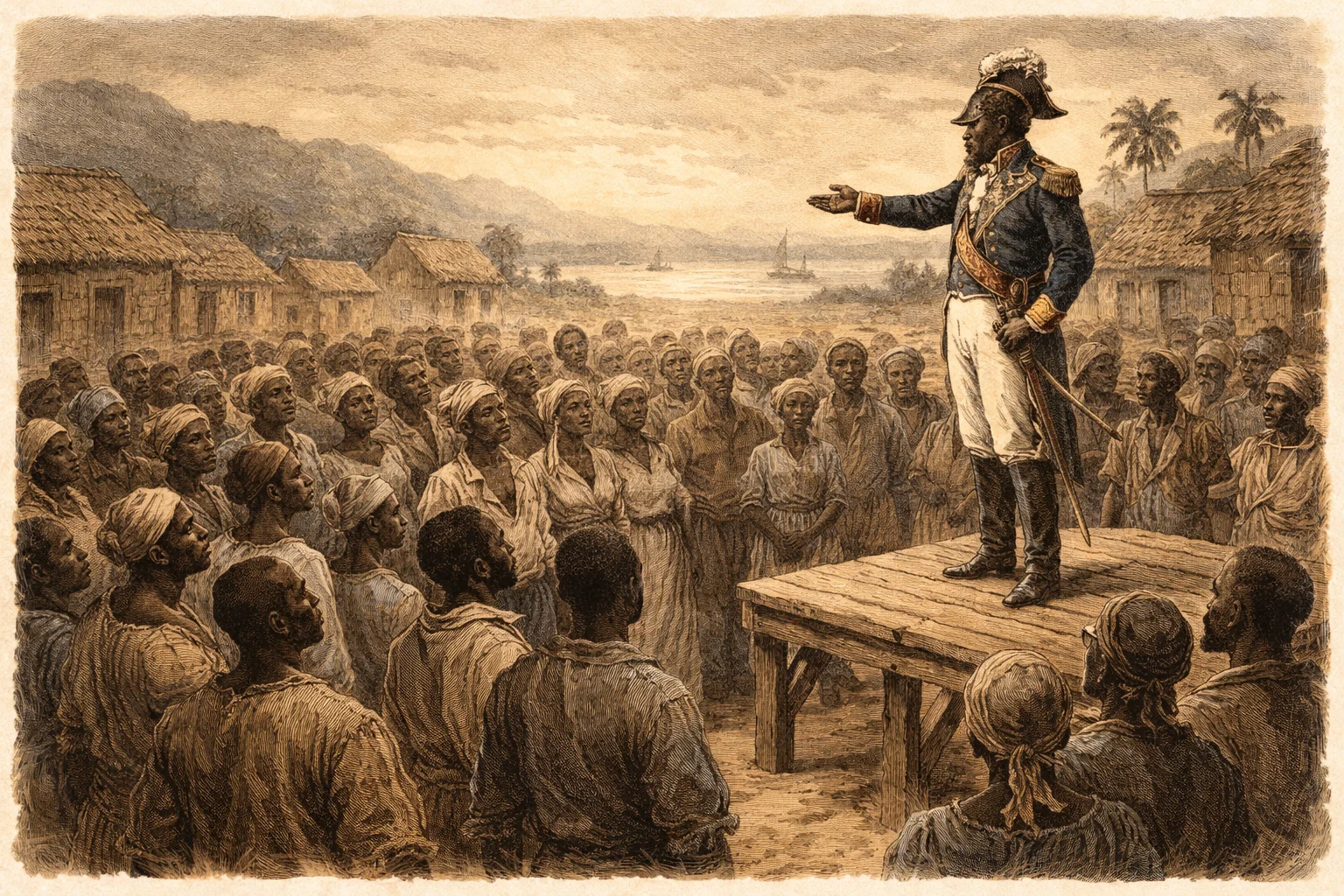
Toussaint Louverture (circa 1743 to 1803) rose from enslavement in Saint-Domingue to become the revolution’s most powerful commander and, by 1801, the colony’s governor-general under a new constitution that banned slavery while keeping the plantation economy running.
His greatest achievement was building enough military and political leverage to make emancipation irreversible in practice, even as his labor policies and centralized rule created lasting controversy. He was removed during Napoleon’s attempt to reconquer the colony in 1802 and died imprisoned in France in 1803, before Haitian independence was declared in 1804.
Quick navigation:
How to use this biography |
Early life |
1791 uprising |
Switching sides |
Power and civil war |
1801 constitution |
1802 expedition and death |
Timeline |
FAQ
How to use this biography: what is well-established, and what is debated
This page is written as a source-based biography you can cite. It is designed for students, diaspora readers, and general history learners who want a reliable narrative without losing the hard parts: the tradeoffs between emancipation, war, and rebuilding an economy.
Well-established anchors in this biography rely on institutional references and primary documents, such as the 1801 Constitution and the laws Louverture promulgated afterward. These allow you to quote the legal record directly, not just summaries of it. See the full text of the 1801 Constitution here: University of Warwick, Haitian Constitution of 1801 (PDF). If you want the related legal framework issued in mid-1801, jump ahead to the constitution section.
Debated questions are labeled as debate, not hidden. Examples include how to judge Louverture’s labor regime, how to interpret his island-wide ambitions, and how much of his governing style was necessity versus preference. For a Haitian oral-history style account that emphasizes Creole social categories, political motives, and local memory, see: Historian Jean Julien lecture (YouTube). You can also jump to Power and civil war for how that tradition frames conflict and authority.
Early life in Saint-Domingue: origins, formation, and the question of freedom
Toussaint Louverture was born around 1743 in the French colony of Saint-Domingue and spent his early life inside the plantation system that made the colony wealthy and brutal. A core baseline fact, supported by reference scholarship, is that he was manumitted before the revolution’s outbreak, meaning his rise cannot be explained only as a sudden transformation in 1791. Encyclopaedia Britannica
In Haitian oral-history framing, Jean Julien describes Toussaint as a kreyòl (Creole, locally born) associated with the Breda plantation near Cap-Haïtien, not a bosal (African-born). Julien also preserves local descriptors, including the nickname fatra baton, and emphasizes skills that mattered later in war and administration: horsemanship, coachman work, and practical discipline. Historian Jean Julien lecture (YouTube)
Two details matter for readers trying to understand his later choices.
- He learned to navigate power before the revolution. If you accept the “freed before 1791” baseline, then Toussaint’s early advantage was access: networks, mobility, and the ability to learn administrative habits that field labor often denied. See the timeline for the key dates.
- He operated between worlds. Even when sources disagree on how much formal schooling he received, the consistent picture is a leader who could move between military command, political negotiation, and religious or civic legitimacy when the colony broke into civil war. Return to the methodology section
August 1791: uprising, civil war, and why “1791” is not a single event
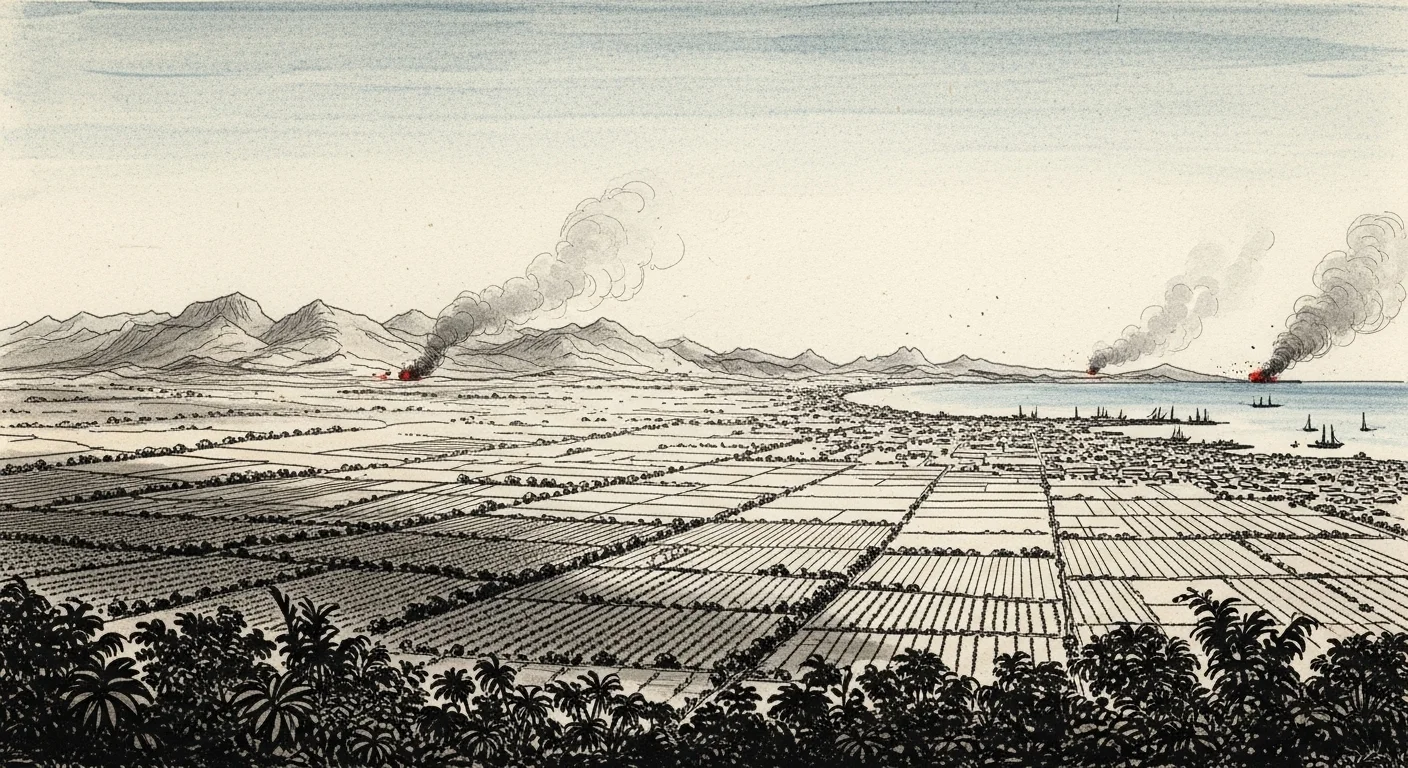
The Haitian Revolution began with a mass uprising in the northern plain in late August 1791, and it rapidly expanded into a multi-sided conflict involving French authorities, free people of color, enslaved rebels, and foreign powers. This matters because it prevents a common mistake: treating the revolution as a straight line from uprising to independence, rather than a long, shifting war of survival, legitimacy, and alliance. U.S. Office of the Historian
In this opening phase, leadership meant more than ideology. Commanders needed discipline, supply lines, and the ability to negotiate with competing factions. Toussaint’s emergence should be read in that context: a crisis where military organization became a form of political authority.
If you are using this biography for research or classwork, keep two cross-check rules in mind:
- Separate “uprising” from “state-building.” The uprising begins a war; it does not automatically produce a government. Jump ahead to the 1801 constitution for the turning point where law and administration take center stage.
- Track foreign pressure early. International conflict shaped every major decision. The Office of the Historian overview is useful for seeing how outside powers pulled the colony into wider Atlantic politics. U.S. Office of the Historian
From Spanish ally to French general: why he switched allegiance in 1794
One of the most cited turning points in Toussaint’s career is his shift from the Spanish camp to the French in 1794. In simple terms, he recognized that the French revolutionary regime’s emancipation policy changed the strategic meaning of alliance. A move toward France could be presented as consistent with an anti-slavery outcome, while Spain and Britain remained tied to slaveholding imperial systems. Encyclopaedia Britannica
This switch also shows how he built legitimacy. In revolutionary warfare, legitimacy is not only moral, it is logistical. An army needs supplies, promotions, and a chain of command. A commission in the French army gave Toussaint a framework to expand authority while continuing to fight rivals on the ground.
For readers, the key is to avoid moralizing shortcuts. “Switching sides” was not only personal ambition or pure principle. It was a calculation inside a war where emancipation, security, and sovereignty were not yet aligned.
- Next: Power and civil war
- Reference anchor: Timeline of key events
Power struggles, civil war, and the costs of consolidation
By the late 1790s, conflict was no longer only against foreign forces. It also became a contest over who would govern, whose interests would dominate, and how emancipation would be enforced. In Haitian oral-history narration, Jean Julien emphasizes a sequence of political confrontations and expulsions of French officials, followed by open conflict that widened racial and regional divisions, culminating in Toussaint’s consolidation of authority across the colony. Historian Jean Julien lecture (YouTube)
Whether you rely more on institutional summaries or Haitian lecture tradition, the analytical point is the same: revolution creates new power, and new power creates new conflicts. Toussaint’s consolidation produced order, but it also produced fear, resentment, and resistance among people who believed emancipation should mean full autonomy over work and land.
If you are writing a paper, this is the section where you can frame the central debate without collapsing into “hero” versus “villain.” Here is a practical way to hold the tension:
- Emancipation demanded protection. Without an army and leadership, foreign reconquest could restore slavery in practice.
- Protection demanded production. War and diplomacy required resources, and resources often meant forcing plantations to function.
- Production demanded coercion. This is where many freed people resisted, and where Toussaint’s legacy becomes contested rather than purely celebratory.
Continue to the 1801 constitution to see how these choices became law, not only policy. For a quick scaffold of dates, use the timeline.
The 1801 Constitution and colonial law: autonomy without formal independence

In 1801, Toussaint’s government promulgated the Constitution of Saint-Domingue, a landmark attempt to define autonomy while still describing the colony as connected to France. This document matters because it shows what he was building: a centralized executive regime designed to survive foreign pressure and internal conflict. University of Warwick, Haitian Constitution of 1801 (PDF)
Primary-source anchor: the constitution states that slavery is not permitted. One widely cited line reads: “There cannot exist slaves on this territory…” University of Warwick, Haitian Constitution of 1801 (PDF)
That single legal statement helps you explain why 1801 is pivotal even though independence was not declared then. A constitution is a claim about sovereignty. It creates an internal legal order, even if external recognition is uncertain.
To see how constitutional authority became day-to-day administration, the Library of Congress digitization of Louverture-era laws is unusually valuable. It summarizes a compilation of laws promulgated in July and August 1801 on topics ranging from territorial administration to courts, public health, and the militia. Library of Congress, Laws of the French Colony of Saint-Domingue
- Jump forward: 1802 expedition and arrest
- Jump back: Power and civil war
Napoleon’s 1802 expedition, arrest, and death in 1803
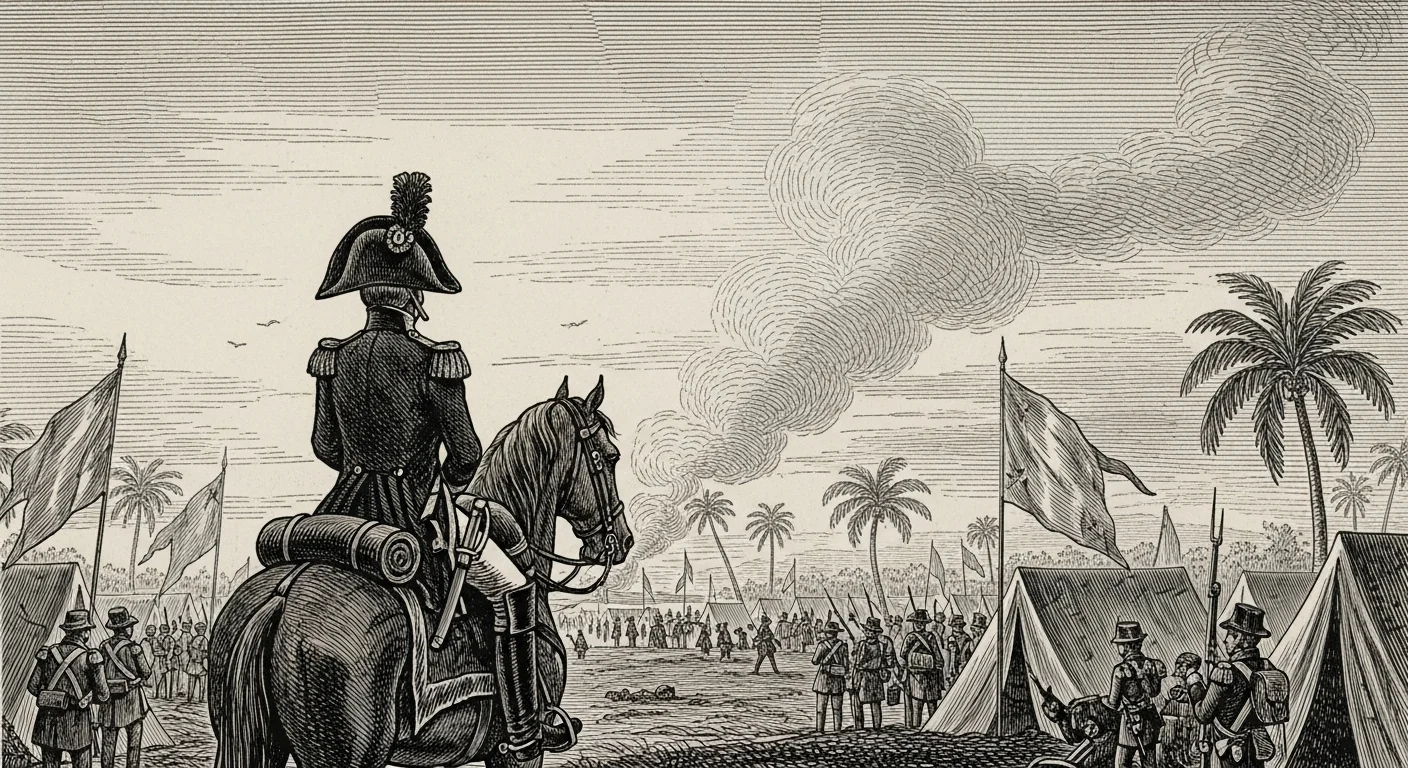
Napoleon’s government attempted to reassert control over Saint-Domingue, and the conflict escalated as French forces returned to the colony. The Library of Congress summary on Louverture-era laws includes a concise overview of the 1802 turning point: Toussaint was forced to relinquish power after defeats inflicted by an invading French army led by General Charles Emmanuel Leclerc, and he was arrested and deported to France. Library of Congress, Laws of the French Colony of Saint-Domingue
He died imprisoned on April 7, 1803. His removal did not end the revolution, but it did reshape it. The final break with France and the declaration of Haitian independence occurred in 1804 under later leadership, in a war that intensified after Toussaint was gone. Library of Congress, Laws of the French Colony of Saint-Domingue
This is also where the “roots and trunk” idea, widely repeated in memory and quotation, becomes meaningful as analysis: Toussaint’s individual fate was not identical to the revolution’s fate. Institutions, commanders, and mass resistance carried the struggle forward after his arrest.
Next steps for readers:
- Use the timeline if you need fast citation-ready structure.
- Use the FAQ if you need short answers to common misconceptions.
Key events in Toussaint Louverture’s life (timeline)
This timeline is designed for quick citation and orientation. Each entry includes a “why it matters” note, and the notes rotate between political, legal, social, and military significance.
- Circa 1743: Toussaint is born in Saint-Domingue. Encyclopaedia Britannica
Why it matters (social): His life begins inside a plantation society where race, labor, and law structured everything, and that structure later becomes the revolution’s target. - Late August 1791: The uprising in the North begins the long revolutionary war. U.S. Office of the Historian
Why it matters (military): The conflict quickly becomes multi-sided and international, making command, logistics, and alliances as important as ideology. - May 1794: Toussaint switches from the Spanish camp to the French and receives a French commission. Encyclopaedia Britannica
Why it matters (political): The shift aligns strategy with emancipation policy and positions him inside a framework that expands authority. - 1799 to 1800: Civil war in the colony culminates in Toussaint’s consolidation of power. Historian Jean Julien lecture (YouTube)
Why it matters (social): Emancipation does not end hierarchy; it can intensify conflict over who governs and what freedom will mean in daily life. - 1801: The Constitution of Saint-Domingue is promulgated and bans slavery in law. University of Warwick, Haitian Constitution of 1801 (PDF)
Why it matters (legal): It turns revolutionary claims into an internal legal order, even without formal independence.
For short answers, go to FAQ. For legal-text citations, return to the constitution section.
FAQ: common questions about Toussaint Louverture
Was Toussaint Louverture the leader who declared Haitian independence?
No. Toussaint was removed in 1802 and died in prison in 1803. Independence was declared in 1804 under later leadership after the war intensified. Library of Congress, Laws of the French Colony of Saint-Domingue
Why did he switch from Spain to France in 1794?
In the simplest source-based explanation, the French emancipation policy changed the strategic meaning of alliance, and Toussaint’s commission in the French army aligned his military position with an anti-slavery outcome. Encyclopaedia Britannica
What did the 1801 Constitution say about slavery?
It states that slavery cannot exist in Saint-Domingue, a legal claim that anchors the autonomy project even though it was not a formal declaration of independence. University of Warwick, Haitian Constitution of 1801 (PDF)
Why do historians argue about his labor and governing policies?
Because rebuilding the colony’s economy and defending emancipation required production, and production often relied on coercive discipline that many freed people resisted. The debate is about necessity, morality, and the long-term meaning of freedom in a post-slavery plantation society. U.S. Office of the Historian
Sources
- Encyclopaedia Britannica: “Toussaint Louverture”
- U.S. Office of the Historian: “Haitian Revolution, 1784 to 1800”
- Library of Congress: “Laws of the French Colony of Saint-Domingue”
- University of Warwick: “Haitian Constitution of 1801” (PDF)
- Historian Jean Julien lecture (YouTube)