Religious syncretism in Haitian Vodou is the deliberate blending of West and Central African spiritual systems with selected Roman Catholic prayers, images, calendars, and ritual forms. In colonial Saint-Domingue, enslaved Africans faced forced public conformity under Catholic rule, so they learned to translate spirits and sacred roles into socially acceptable symbols while preserving older meanings and obligations.
In practice, you might see saint images beside drums, veve, rum, candles, and offerings, or hear Catholic prayers spoken inside ceremonies shaped by African-derived rhythm, dance, and spirit service. Syncretism in Vodou is not random borrowing. It is a survival strategy, a theology of continuity, and a community language that still shapes Vodou practice in Haiti and the diaspora today.
Key Takeaways
- Vodou syncretism blends West and Central African cosmologies with Catholic prayers, saints, and imagery in ways that preserve older meanings under new symbols.
- Colonial pressure and forced public conformity helped make Catholic forms a practical “public cover” for African-derived spiritual life, especially in plantation society.
- Saint and lwa pairings often follow shared roles (protection, healing, gates, justice), but pairings vary by region, temple, and family tradition.
- Syncretism shows up in altars, feast days, prayers, songs, and art where crucifixes and saint prints can appear alongside veve, drums, offerings, and spirit possession.
- Vodou has faced repeated persecution and political manipulation, yet it persists as a living religion tied to healing, community ethics, and Haitian identity.
What Does Syncretism Mean in Haitian Vodou?
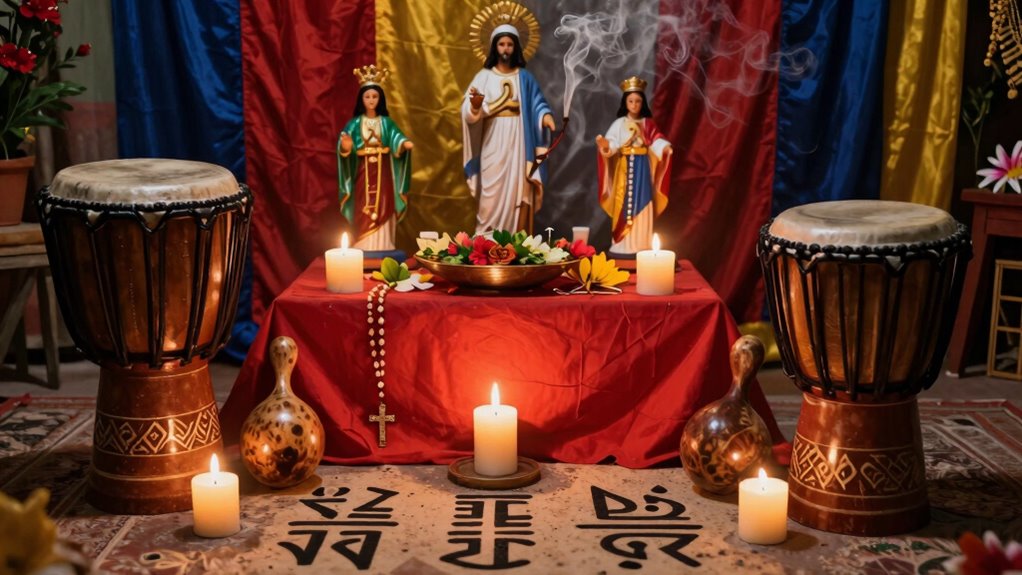
In Haitian Vodou, “syncretism” does not mean a loose mix of two religions. It describes how Vodou communities integrated Catholic elements into an African-derived religious system while keeping Vodou’s core structure intact.
Vodou centers on Bondye (the supreme creator) and the lwa (spirits who mediate power, protection, healing, justice, and everyday life). Devotees “serve the spirits” through songs, offerings, moral obligations, and ritual responsibilities.
Catholic prayers, candles, holy water, and saint imagery can function inside that Vodou framework without turning Vodou into Catholicism. For many practitioners, Catholic forms are respected, but they are interpreted through Vodou’s spiritual logic and community needs.
It is also important to say this clearly: the word “syncretism” can flatten what Vodou practitioners understand as a living, coherent religion. Some scholars describe saint imagery as a historical accommodation that helped Vodou survive, while emphasizing that Vodou theology remains distinct.
In practice, both ideas can be true depending on the community: sometimes Catholic symbols are used as cover, sometimes as genuine devotional language, and often as both at once.
Why Vodou Syncretism Grew Under French Catholic Rule
Syncretism expanded in colonial Saint-Domingue because enslaved Africans were pushed into Catholic life through baptism, church calendars, and public expectations, often without meaningful religious instruction or freedom of practice.
Plantation society also forced people from different African nations and languages into shared spaces, creating pressure to build a common spiritual vocabulary across Dahomean, Kongo, and other traditions. Catholic feast days, processions, images, and prayers became widely available ritual materials.
Vodou communities adapted them into an African-derived system that could meet urgent needs: protection, healing, justice, and moral order in brutal conditions.
That is why syncretism should be understood as strategy and community intelligence. It helped people preserve sacred relationships, transmit ethics, and organize collective life under surveillance and violence.
Primary sources on Haiti’s colonial and revolutionary era
How Lwa Were Linked to Catholic Saints (With Clear Examples)
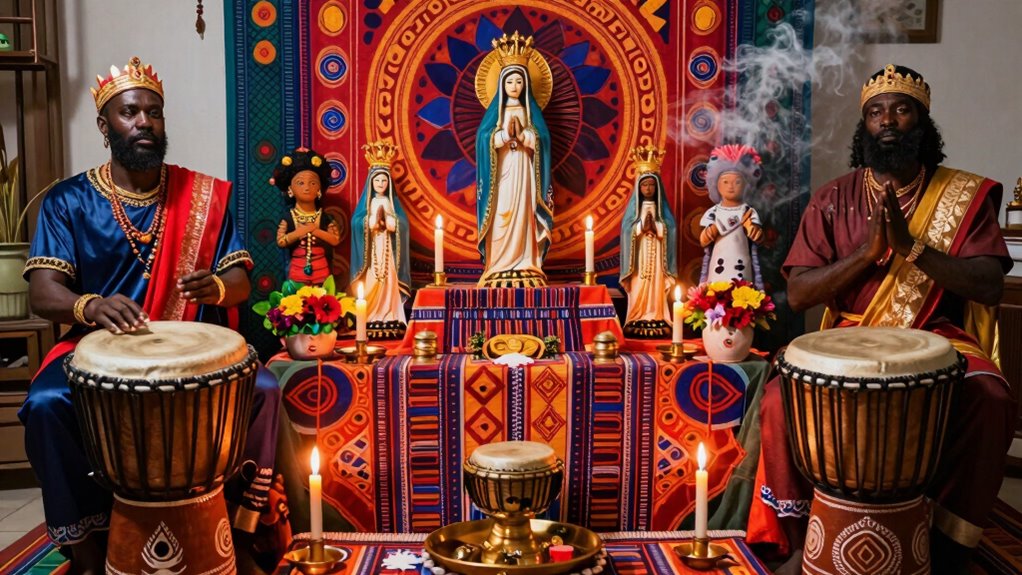
Many Vodou communities mapped lwa to Catholic saints by shared functions rather than by strict one-to-one equivalence. This created a coded public language: a saint’s image could stand in for a lwa, even when the deeper meaning remained Vodou. Pairings vary by region, temple (peristil), and family lineage, but several examples appear repeatedly in Vodou art and teaching:
- Ogou (power, iron, warfare, leadership) is commonly linked with St. James (St. Jacques) in Vodou imagery, especially in flags and paintings where the mounted saint becomes a surrogate for Ogou.
- Danbala (serpent lwa, purity, ancestral depth) is often linked with St. Patrick, whose Christian iconography includes snakes.
- Ezili Danto (fierce protection, motherhood, defense of the vulnerable) is widely associated with Our Lady of Mount Carmel in Afro-Atlantic traditions where saint feast days become public ritual anchors.
These alignments do not mean the lwa “are” the saints. They mean the saint images can function as recognized ritual faces for spirits whose stories, obligations, and powers come from Vodou’s own sacred history.
Ogou and St. Jacques in Vodou flag tradition
Feast days and saint calendars in Vodou traditions
Where Vodou-Catholic Syncretism Shows Up in Ritual and Art
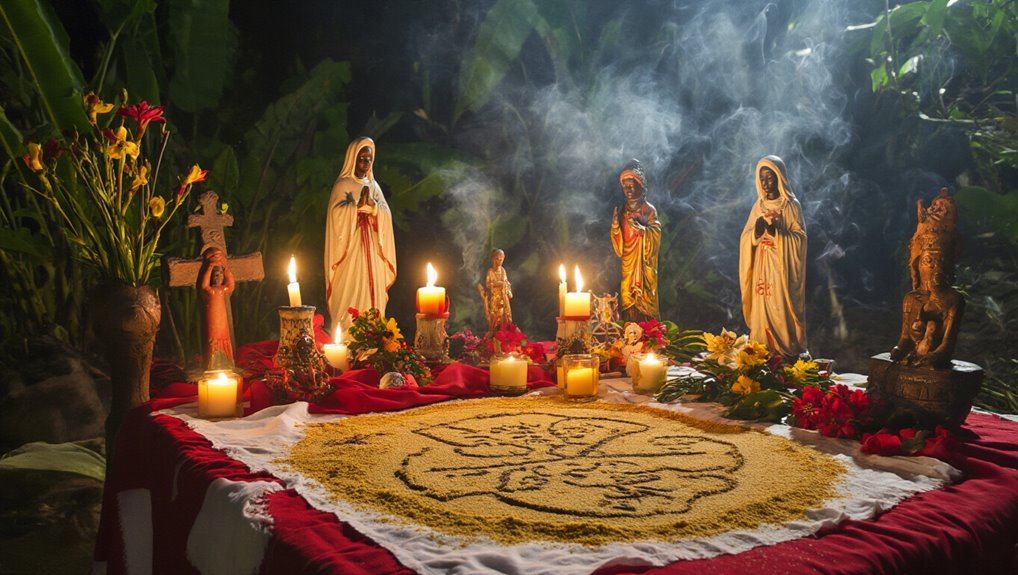
Syncretism becomes most visible in the ritual space. In many ceremonies, Catholic prayers may open a service, candles and holy water may bless the space, and saint images may stand on an altar. At the same time, Vodou’s heart remains present: drumming patterns that call specific lwa, songs in Haitian Creole, dance that carries embodied memory, and spirit possession as a sacred arrival rather than performance.
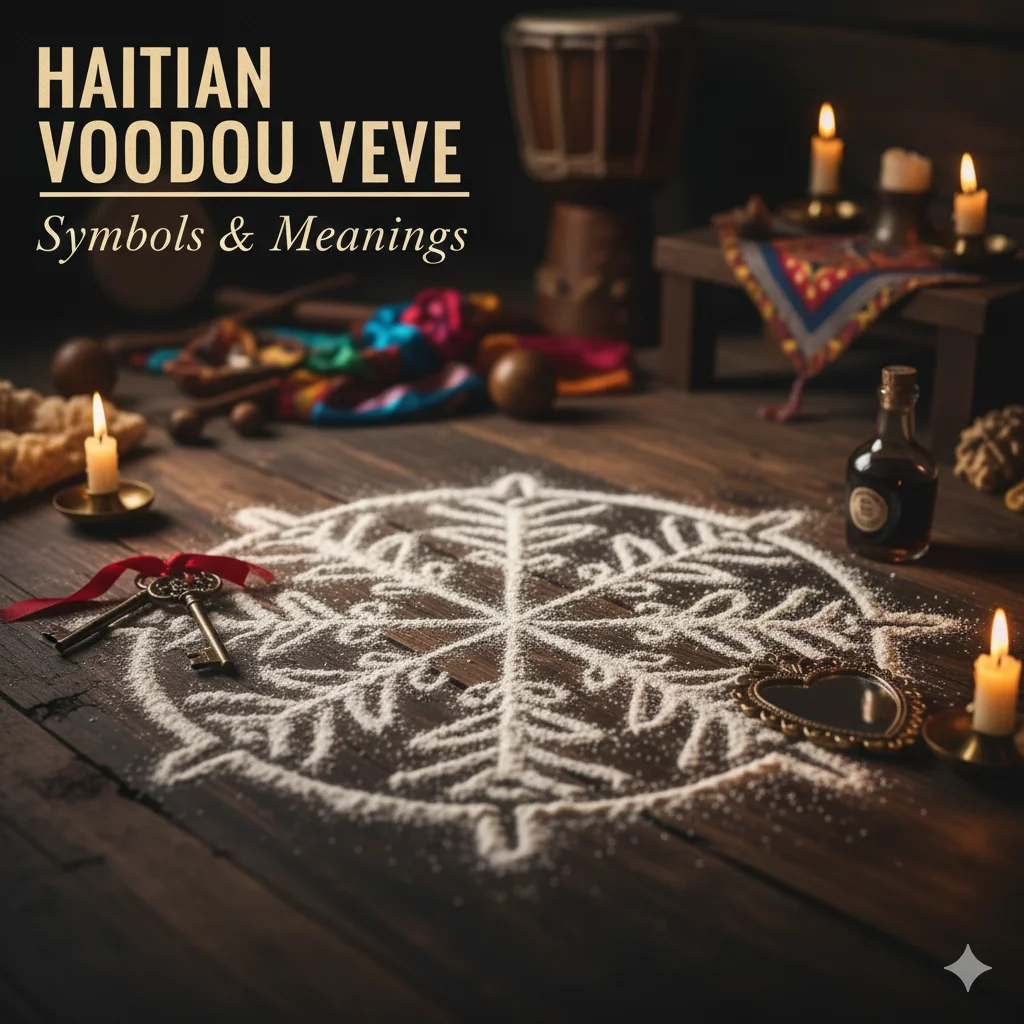
Veve designs (sacred ground drawings) can be traced beneath altars or at the center of the peristil, marking which lwa are being served. Offerings like rum, coffee, water, food, and flowers can sit alongside crosses or saint prints, not as confusion, but as a single ritual economy where objects carry multiple layers of meaning. Vodou art, especially flags (drapo) and chromolithograph-inspired altar displays, makes this blending legible in public.
Common Misunderstandings About Vodou Syncretism
Misunderstanding 1: “Syncretism means Vodou is just Catholicism.” It does not. Vodou recognizes Bondye and serves the lwa through a distinct theology, ritual system, and ethical obligations. Catholic elements can be present, but they operate inside Vodou’s structure.
Misunderstanding 2: “Saints are only disguise.” Disguise mattered historically, but it is not the whole story. In some communities, saint devotion became a real spiritual language alongside Vodou service. In others, saint images remain primarily symbolic cover. The point is that Vodou practice is not static. It adapts to pressure, place, and community lineage.
Misunderstanding 3: “Syncretism is proof Vodou is less coherent.” The opposite is often true. Syncretism shows how Vodou maintained coherence under violence by translating meaning across symbols without surrendering spiritual authority.
Persecution, Politics, and Change
Vodou has repeatedly been targeted as “superstition” or treated as a threat to order. In the twentieth century, anti-Vodou campaigns combined state force and church pressure, sometimes pushing people to publicly renounce Vodou while privately continuing to serve the spirits.
At other moments, political leaders exploited Vodou imagery to project fear, charisma, or spiritual authority. This history matters because it explains why some communities emphasize secrecy, coded language, and layered symbolism, and why syncretism remains a living tool for survival as well as devotion.
Vodou persecution, campaigns, and modern status
Frequently Asked Questions
What Are Lwa in Haitian Vodou?
Lwa are spirits who serve as intermediaries between Bondye (the supreme creator) and humans. Each lwa has specific roles, temperaments, symbols, songs, and ritual obligations. Devotees honor them through service, offerings, prayer, and ceremony, often within inherited family traditions.
Is Haitian Vodou the Same as Catholicism?
No. Vodou is a distinct religion with its own cosmology, spirits, ethics, and ritual system. Catholic prayers and saint images may appear in Vodou practice, but they are interpreted through Vodou’s spiritual logic and community obligations.
Why Do Saints Appear in Vodou Altars and Art?
Saint images provided recognizable public symbolism under colonial and postcolonial pressure. Over time, many communities also treated saint imagery as meaningful devotional language, aligning saints with lwa by shared functions like protection, healing, gates, or justice. Pairings vary by region and lineage.
Can Someone Be Both Catholic and Vodouisant?
Many Haitians experience the two as compatible in daily life. A person may attend Mass, respect saints, and also serve the lwa through family ceremonies. Others keep the traditions separate or reject one entirely. In practice, identity and community history often shape how people integrate beliefs.
How Did Vodou Influence the Haitian Revolution?
Vodou helped build trust, shared identity, and coordination across plantations by creating meeting networks, ritual bonds, and a moral language of resistance. It also offered spiritual legitimacy against slavery and colonial rule. Its influence is best understood as social and spiritual infrastructure that supported mobilization under extreme repression.
How Did Duvalier Use Vodou Imagery for Power?
François “Papa Doc” Duvalier used Vodou imagery and spiritual symbolism to project authority, fear, and nationalist legitimacy. He blurred the boundary between state power and spiritual power, amplified rumors, and encouraged an atmosphere where spiritual dread supported political control. This was not “Vodou rule” over the state, but political manipulation of religious symbols inside a climate of repression.
Conclusion
Haitian Vodou syncretism shows how enslaved and oppressed communities protected sacred traditions by translating them into publicly legible forms. Saints, prayers, and Catholic calendars became tools that could preserve African-derived meanings, not erase them.
Today, crosses and candles can still coexist with veve, drums, and offerings, not as contradiction, but as layered continuity. Syncretism is best understood as adaptation with purpose: a way of keeping faith coherent, communal, and alive under pressure.
References
- https://www.britannica.com/topic/lwa
- https://5colldh.org/islandora/object/5colldh%3A131434
- https://www.britannica.com/place/Ouidah
- https://guides.loc.gov/haiti-reimagined/primary-resources
- https://apnews.com/article/haiti-vodou-bca11cbe38aa74b52f1c9400cefb3b28
- Métraux, Alfred. Voodoo in Haiti. (Foundational ethnography on Haitian Vodou.)
- Brown, Karen McCarthy. Mama Lola: A Vodou Priestess in Brooklyn. (Classic ethnography on Vodou practice and diaspora life.)